

How to Choose the Right Barcode Label Material for Your IndustryChoosing the correct barcode label material is one of the most important decisions businesses make when implementing a labeling or tracking system. While barcode printers and scanners often receive most of the attention, the label material itself determines how long a label lasts, how well it scans, and whether it performs reliably in real-world conditions.
From warehouses and retail stores to healthcare facilities and industrial plants, every industry has unique labeling requirements. Using the wrong barcode label can result in faded print, unreadable codes, peeling labels, and costly operational errors.
At Labels and Labeling, a trusted barcode label supplier in Dubai, we help businesses across the UAE select barcode label materials that deliver durability, accuracy, and long-term performance. This guide explains how to choose the right barcode label material based on industry usage, environment, and application.
Why Barcode Label Material Matters
A barcode label is more than just a printed sticker. It is a critical data carrier that must remain readable throughout its lifecycle.
The right label material ensures:
✔ Clear barcode scanning
✔ Resistance to damage
✔ Long service life
✔ Reduced reprinting costs
✔ Smooth integration with POS, WMS, and ERP systems
Selecting the wrong material can lead to:
❌ Barcode scan failures
❌ Inventory errors
❌ Shipping delays
❌ Compliance issues
❌ Increased replacement costs

Key Factors to Consider When Choosing a Barcode Label
Before selecting a barcode label material, consider these important factors:
1️⃣ Environment
Will the label be exposed to:
Heat or cold?
Moisture or humidity?
Chemicals or oils?
Outdoor conditions?
Environmental exposure plays a major role in material selection.
2️⃣ Label Lifespan
Ask yourself:
Is this a temporary label or long-term identification?
Does the label need to last days, months, or years?
Short-term labels differ greatly from asset or industrial barcode labels.
3️⃣ Surface Type
Barcode labels may be applied to:
Plastic
Cardboard
Glass
Metal
Rough or curved surfaces
The surface determines the adhesive and material type required.
4️⃣ Printing Method
Compatibility with:
Thermal transfer printing
Direct thermal printing
Some materials require ribbon printing, while others do not.
Common Barcode Label Materials & Their Uses
Below is a breakdown of the most commonly used barcode label materials and the industries they serve.
1. Paper Barcode Labels
✅ Best for: Short-Term & Indoor Use
Paper labels are the most commonly used and cost-effective barcode labels.
Key Features:
Budget-friendly
Easy to print
Excellent scan clarity
Best for controlled environments
Common Applications:
Retail price labels
Shipping and logistics
Warehouse cartons
Office inventory
📌 Not suitable for moisture, heat, or abrasion.
2. Direct Thermal Barcode Labels
✅ Best for: Short-Life Labels
Direct thermal labels do not require ink or ribbon.
Key Features:
Quick and economical printing
Ideal for high-volume usage
Fades over time when exposed to heat or sunlight
Common Applications:
Courier labels
Shipping labels
E-commerce packaging
📌 Best for labels with a short lifespan.
3. Thermal Transfer Barcode Labels (Synthetic)
Synthetic barcode labels offer higher durability and performance.
Materials include:
Polypropylene (PP)
Polyester (PET)
Vinyl
Key Features:
Smudge-resistant
Waterproof and tear-resistant
Longer lifespan
Common Applications:
Warehouse racking
Industrial labeling
Product identification
Logistics pallets
4. Polyester (PET) Barcode Labels
✅ Best for: Industrial & Asset Tracking
Polyester barcode labels provide excellent durability.
Key Features:
Heat resistant
Chemical resistant
Long-term readability
Strong adhesive bonding
Common Applications:
Asset labels
Electronic equipment
Machinery identification
Outdoor usage
5. Vinyl Barcode Labels
✅ Best for: Curved & Uneven Surfaces
Vinyl labels are flexible and adaptable.
Key Features:
Conformable on curved surfaces
Weather-resistant
Good chemical resistance
Common Applications:
Cylindrical containers
Pipes and drums
Automotive parts
6. Polypropylene (PP) Barcode Labels
✅ Best for: Product & Food Packaging
Polypropylene labels balance cost and durability.
Key Features:
Moisture-resistant
Smooth print surface
Cost-effective synthetic option
Common Applications:
Food packaging
Cosmetic labeling
Retail products
7. Tamper-Evident Barcode Labels
✅ Best for: Security & High-Value Assets
These labels prevent unauthorized removal.
Key Features:
VOID or destructive material
Enhanced asset security
Cannot be reused
Common Applications:
IT assets
Electronics
Security equipment
Industry-Wise Barcode Label Material Guide
🏬 Retail & E-commerce
Paper or direct thermal labels
Cost-efficient and fast printing
📦 Warehousing & Logistics
Thermal transfer synthetic labels
Strong adhesive and abrasion resistance
🏭 Manufacturing & Industrial
Polyester or vinyl labels
Heat and chemical resistance
🏥 Healthcare & Pharmaceuticals
Synthetic and laboratory-grade labels
Chemical-resistant and smudge-proof
🏢 IT & Asset Management
Polyester or tamper-evident labels
Long-term durability and security
Why Choose Labels and Labeling for Barcode Labels in UAE
As a trusted barcode label supplier in Dubai, Labels and Labeling offers:
✔ Wide range of barcode label materials
✔ Expert consultation & guidance
✔ Custom sizes, adhesives & finishes
✔ High scan accuracy and precision printing
✔ Compatibility with Zebra & other printers
✔ Fast delivery across UAE
We don’t just supply labels — we ensure they work perfectly in your environment.
How We Help You Choose the Right Barcode Label
Our selection process includes:
Application analysis
Environment evaluation
Surface testing
Printer compatibility checks
This ensures the barcode label performs reliably from day one.
🔚 Conclusion
Choosing the right barcode label material is essential for operational efficiency, accuracy, and cost control. Each industry has unique requirements, and selecting the wrong label can cause scanning failures and unnecessary replacements.
With expert guidance and a wide selection of high-quality materials, Labels and Labeling helps businesses across the UAE choose barcode labels that deliver durability, readability, and long-term performance.
📞 Contact Labels and Labeling today
Get the right barcode label solution tailored to your industry needs.
✅ FAQs
Q1: What is the most durable barcode label material?
Polyester and vinyl labels are the most durable for industrial use.
Q2: Are paper barcode labels suitable for warehouses?
Only for dry, indoor environments. Synthetic labels are better for heavy use.
Q3: Do you supply custom barcode labels in UAE?
Yes, custom sizes, materials, and adhesives are available.
Choosing the correct barcode label material is one of the most important decisions businesses make when implementing a labeling or tracking system. While barcode printers and scanners often receive most of the attention, the label material itself determines how long a label lasts, how well it scans, and whether it performs reliably in real-world conditions.
From warehouses and retail stores to healthcare facilities and industrial plants, every industry has unique labeling requirements. Using the wrong barcode label can result in faded print, unreadable codes, peeling labels, and costly operational errors.
At Labels and Labeling, a trusted barcode label supplier in Dubai, we help businesses across the UAE select barcode label materials that deliver durability, accuracy, and long-term performance. This guide explains how to choose the right barcode label material based on industry usage, environment, and application.
Why Barcode Label Material Matters
A barcode label is more than just a printed sticker. It is a critical data carrier that must remain readable throughout its lifecycle.
The right label material ensures:
✔ Clear barcode scanning
✔ Resistance to damage
✔ Long service life
✔ Reduced reprinting costs
✔ Smooth integration with POS, WMS, and ERP systems
Selecting the wrong material can lead to:
❌ Barcode scan failures
❌ Inventory errors
❌ Shipping delays
❌ Compliance issues
❌ Increased replacement costs
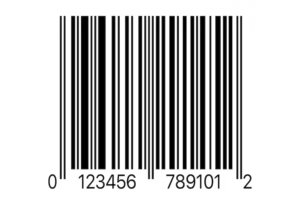
Key Factors to Consider When Choosing a Barcode Label
Before selecting a barcode label material, consider these important factors:
1️⃣ Environment
Will the label be exposed to:
Heat or cold?
Moisture or humidity?
Chemicals or oils?
Outdoor conditions?
Environmental exposure plays a major role in material selection.
2️⃣ Label Lifespan
Ask yourself:
Is this a temporary label or long-term identification?
Does the label need to last days, months, or years?
Short-term labels differ greatly from asset or industrial barcode labels.
3️⃣ Surface Type
Barcode labels may be applied to:
Plastic
Cardboard
Glass
Metal
Rough or curved surfaces
The surface determines the adhesive and material type required.
4️⃣ Printing Method
Compatibility with:
Thermal transfer printing
Direct thermal printing
Some materials require ribbon printing, while others do not.
Common Barcode Label Materials & Their Uses
Below is a breakdown of the most commonly used barcode label materials and the industries they serve.
1. Paper Barcode Labels
✅ Best for: Short-Term & Indoor Use
Paper labels are the most commonly used and cost-effective barcode labels.
Key Features:
Budget-friendly
Easy to print
Excellent scan clarity
Best for controlled environments
Common Applications:
Retail price labels
Shipping and logistics
Warehouse cartons
Office inventory
📌 Not suitable for moisture, heat, or abrasion.
2. Direct Thermal Barcode Labels
✅ Best for: Short-Life Labels
Direct thermal labels do not require ink or ribbon.
Key Features:
Quick and economical printing
Ideal for high-volume usage
Fades over time when exposed to heat or sunlight
Common Applications:
Courier labels
Shipping labels
E-commerce packaging
📌 Best for labels with a short lifespan.
3. Thermal Transfer Barcode Labels (Synthetic)
Synthetic barcode labels offer higher durability and performance.
Materials include:
Polypropylene (PP)
Polyester (PET)
Vinyl
Key Features:
Smudge-resistant
Waterproof and tear-resistant
Longer lifespan
Common Applications:
Warehouse racking
Industrial labeling
Product identification
Logistics pallets
4. Polyester (PET) Barcode Labels
✅ Best for: Industrial & Asset Tracking
Polyester barcode labels provide excellent durability.
Key Features:
Heat resistant
Chemical resistant
Long-term readability
Strong adhesive bonding
Common Applications:
Asset labels
Electronic equipment
Machinery identification
Outdoor usage
5. Vinyl Barcode Labels
✅ Best for: Curved & Uneven Surfaces
Vinyl labels are flexible and adaptable.
Key Features:
Conformable on curved surfaces
Weather-resistant
Good chemical resistance
Common Applications:
Cylindrical containers
Pipes and drums
Automotive parts
6. Polypropylene (PP) Barcode Labels
✅ Best for: Product & Food Packaging
Polypropylene labels balance cost and durability.
Key Features:
Moisture-resistant
Smooth print surface
Cost-effective synthetic option
Common Applications:
Food packaging
Cosmetic labeling
Retail products
7. Tamper-Evident Barcode Labels
✅ Best for: Security & High-Value Assets
These labels prevent unauthorized removal.
Key Features:
VOID or destructive material
Enhanced asset security
Cannot be reused
Common Applications:
IT assets
Electronics
Security equipment
Industry-Wise Barcode Label Material Guide
🏬 Retail & E-commerce
Paper or direct thermal labels
Cost-efficient and fast printing
📦 Warehousing & Logistics
Thermal transfer synthetic labels
Strong adhesive and abrasion resistance
🏭 Manufacturing & Industrial
Polyester or vinyl labels
Heat and chemical resistance
🏥 Healthcare & Pharmaceuticals
Synthetic and laboratory-grade labels
Chemical-resistant and smudge-proof
🏢 IT & Asset Management
Polyester or tamper-evident labels
Long-term durability and security
Why Choose Labels and Labeling for Barcode Labels in UAE
As a trusted barcode label supplier in Dubai, Labels and Labeling offers:
✔ Wide range of barcode label materials
✔ Expert consultation & guidance
✔ Custom sizes, adhesives & finishes
✔ High scan accuracy and precision printing
✔ Compatibility with Zebra & other printers
✔ Fast delivery across UAE
We don’t just supply labels — we ensure they work perfectly in your environment.
How We Help You Choose the Right Barcode Label
Our selection process includes:
Application analysis
Environment evaluation
Surface testing
Printer compatibility checks
This ensures the barcode label performs reliably from day one.
🔚 Conclusion
Choosing the right barcode label material is essential for operational efficiency, accuracy, and cost control. Each industry has unique requirements, and selecting the wrong label can cause scanning failures and unnecessary replacements.
With expert guidance and a wide selection of high-quality materials, Labels and Labeling helps businesses across the UAE choose barcode labels that deliver durability, readability, and long-term performance.
📞 Contact Labels and Labeling today
Get the right barcode label solution tailored to your industry needs.
✅ FAQs
Q1: What is the most durable barcode label material?
Polyester and vinyl labels are the most durable for industrial use.
Q2: Are paper barcode labels suitable for warehouses?
Only for dry, indoor environments. Synthetic labels are better for heavy use.
Q3: Do you supply custom barcode labels in UAE?
Yes, custom sizes, materials, and adhesives are available.
Comments are closed.