
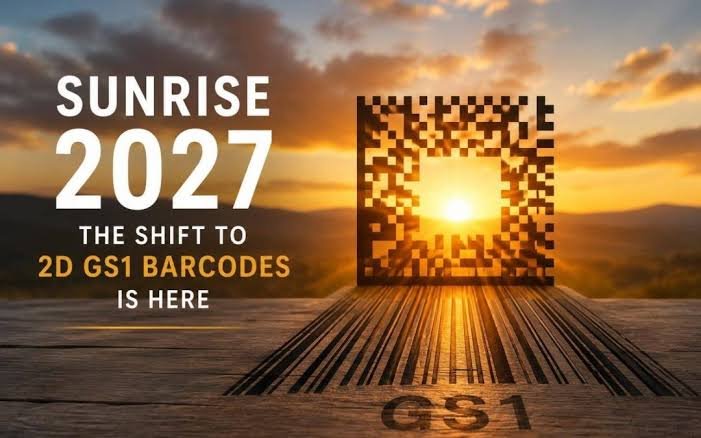
GS1 Sunrise 2027: What 2D Barcodes Mean for UAE Retailers and BrandsSunrise 2027 is the retail industry’s target for checkouts around the world to be able to read 2D barcodes, such as a QR code carrying a GS1 Digital Link or a GS1 DataMatrix, by the end of 2027. It’s an industry goal coordinated by GS1, not a law, and the EAN-13 barcode isn’t being retired. Products will carry both for years. For UAE retailers, the question is whether your scanners and POS software can read 2D codes. For brands, it’s whether the QR code you already print could do the checkout’s job as well.
What Sunrise 2027 is, and what it isn’t
GS1, the organisation behind the barcode on almost every retail product, calls it Ambition 2027: by the end of 2027, “all retail POS systems should be capable of reading and processing a defined set of 2D barcodes with GS1 standards”. GS1 US runs its programme under the name Sunrise 2027. GS1 UAE said in 2023 that it supports the ambition to read 2D barcodes at retail points of sale around the world by the end of 2027, and that it expects 1D, QR and DataMatrix codes to coexist.
It isn’t a deadline for brands to replace their barcodes. GS1’s 2D playbook says that linear barcodes such as EAN/UPC and GS1 DataBar “will not go away”. Lindsay Hillman of GS1 US put it more simply in October 2026: “This is a sunrise, not a sunset.”
Why retailers want 2D barcodes
An EAN-13 barcode carries one thing: the product’s GTIN, its global trade item number. That’s enough to look up a price. A 2D barcode can carry the GTIN plus a batch or lot number, an expiry date and a serial number, which lets the till catch a recalled batch or an expired product before it’s sold.
The same code can also take shoppers to product information on their phones. GS1’s stated aim is for each product to carry “a single multipurpose 2D barcode” that works at the checkout and opens digital content such as instructions, certifications and product information.
Healthcare in the UAE is already further along. Tatmeen, the national platform the Ministry of Health and Prevention uses to trace medicines, works on serialisation in line with GS1 standards, and MOHAP describes a GS1 DataMatrix barcode on packs that members of the public can scan.
The 2D barcodes checkouts will read
GS1’s 2D barcodes at retail point-of-sale implementation guideline (release 1.1.0, December 2025) names three options:
- QR Code with GS1 Digital Link URI syntax
- Data Matrix with GS1 Digital Link URI syntax
- GS1 DataMatrix
A GS1 Digital Link is a web address with the product’s identifiers built into it. Here’s what one looks like (the GTIN and batch number are examples):
https://brand.example/01/09506000134352/10/ABC123
The 14-digit number after /01/ is the GTIN, and the code after /10/ is the batch or lot. Scan it with a phone and it opens a web page. Scan it at a checkout running suitable software and the till pulls out the GTIN and looks up the price, just as it does with the EAN-13.
Your marketing QR code probably doesn’t count
A lot of UAE packaging already carries a QR code that opens a website or an Instagram page. That code holds a plain web address with no GTIN in it, so a checkout can’t use it to identify the product. GS1’s guidance warns that barcodes not intended for retail “could be acknowledged with a beep but typically will not complete price look up”.
The fix is to rebuild the QR code as a GS1 Digital Link that includes your GTIN, which is the first step GS1 US recommends for brands. The code can still send shoppers to the same web page. Only the structure of the address inside it changes. Most free QR code generators make ordinary QR codes, so check that whichever tool or agency you use can produce GS1 Digital Link codes.
If you’re weighing up QR codes against standard barcodes for your own labels, our comparison of barcode labels and QR code labels covers the basics.
The EAN-13 stays, with the 2D code beside it
During the transition, products carry both barcodes. GS1’s guideline says a product using a 2D barcode will need to be accompanied by a linear barcode until 90% of POS scanning solutions can read GS1 compliant 2D barcodes. It also sets some practical rules:
- Place the 2D barcode within 50 mm of the centre of the linear barcode, so scanning speed at the till doesn’t suffer.
- Size the 2D code from the GS1 symbol specification tables. Its X-dimension (the size of the smallest module) is 1.5 times the equivalent X-dimension allowed for the linear barcode.
- Use the same GTIN in both codes.
What UAE retailers should check now
- Check your scanner hardware. Laser scanners and linear imagers read 1D barcodes only, and reading 2D codes needs an area imager. A quick test: if a scanner reads a printed QR code, the hardware can read 2D. Our guide to the types of barcode scanner explains the difference.
- Check your POS software. Reading the code is only half the job. The software must extract the GTIN from a GS1 Digital Link or GS1 DataMatrix and run the normal price look-up. Ask your POS provider whether it supports both, and test with real products.
- Check your handheld devices. If you use PDA devices for receiving and stock counts, make sure they read 2D codes too, so batch and expiry data can be captured at the back door as well as the till.
- Time your replacements. You don’t need to throw out working scanners today. When you do replace them, buy 2D imagers so you only buy once.
What UAE brands and manufacturers should check now
- Make sure every product has a proper GTIN. In the UAE these come from GS1 UAE, and the 2D code uses the same GTIN as your EAN-13.
- Rebuild your existing marketing QR codes as GS1 Digital Link codes with the GTIN included.
- Keep printing the EAN-13, and place the 2D code within 50 mm of it.
- Decide what extra data is worth carrying. GS1 US suggests adding data such as production or expiry dates once the basics are in place.
- Print 2D codes cleanly. Small 2D codes show print faults quickly, so choose a printer resolution that suits the code size, keep dark modules on a light background, and check codes before a full production run. Our guide to barcode labels that scan covers print quality.
- Test with real scanners, and ask your main retail customers whether their tills read 2D codes yet.
Where we fit in
We supply barcode scanners from brands including Zebra and Datalogic, QR code scanners that read 2D codes, PDA devices for stock and receiving, and barcode labels and printers for printing 2D codes on your own products. If your scanners are due for replacement in the next year or two, talk to us about 2D imagers now so the next purchase covers 2027 and beyond.
Visit: Office M04, AB Plaza-2 Building, near Al Qiyada Metro Station, Abuhail, Deira, Dubai · Call: +971 4 2715807 · Mobile: +971 55 7994752 · Email: sales@labelsandlabeling.ae
Frequently asked questions
What is GS1 Sunrise 2027?
An industry target, coordinated by GS1, for retail checkouts to be able to read 2D barcodes such as QR codes with GS1 Digital Link and GS1 DataMatrix by the end of 2027. GS1 US calls it Sunrise 2027, and GS1 globally calls it Ambition 2027.
Is Sunrise 2027 mandatory in the UAE?
Sunrise 2027 is an industry goal, not a law, and we’re not aware of any UAE regulation that requires retailers to scan 2D barcodes at the till. Some sectors have their own rules: medicines in the UAE are traced through the Tatmeen platform, which uses GS1 standards.
Will EAN-13 barcodes stop working after 2027?
No. GS1 says linear barcodes such as EAN/UPC will not go away. Products that use a 2D barcode at retail will also carry a linear barcode until 90% of POS scanning systems can read GS1 2D barcodes.
Which 2D barcodes will retail checkouts read?
GS1’s retail guideline names three: QR Code with GS1 Digital Link URI syntax, Data Matrix with GS1 Digital Link URI syntax, and GS1 DataMatrix.
Can my barcode scanner read 2D barcodes?
Only if it’s an area imager. Laser scanners and linear imagers read 1D barcodes only. If your scanner reads a printed QR code, the hardware can read 2D codes, but your POS software also has to extract the GTIN.
Can I use any QR code on my product packaging?
For marketing, yes. For checkout scanning, the QR code has to follow GS1 Digital Link and include your product’s GTIN. A plain web-address QR code may beep at the till but typically won’t find the price.
Sunrise 2027 is the retail industry’s target for checkouts around the world to be able to read 2D barcodes, such as a QR code carrying a GS1 Digital Link or a GS1 DataMatrix, by the end of 2027. It’s an industry goal coordinated by GS1, not a law, and the EAN-13 barcode isn’t being retired. Products will carry both for years. For UAE retailers, the question is whether your scanners and POS software can read 2D codes. For brands, it’s whether the QR code you already print could do the checkout’s job as well.
What Sunrise 2027 is, and what it isn’t
GS1, the organisation behind the barcode on almost every retail product, calls it Ambition 2027: by the end of 2027, “all retail POS systems should be capable of reading and processing a defined set of 2D barcodes with GS1 standards”. GS1 US runs its programme under the name Sunrise 2027. GS1 UAE said in 2023 that it supports the ambition to read 2D barcodes at retail points of sale around the world by the end of 2027, and that it expects 1D, QR and DataMatrix codes to coexist.
It isn’t a deadline for brands to replace their barcodes. GS1’s 2D playbook says that linear barcodes such as EAN/UPC and GS1 DataBar “will not go away”. Lindsay Hillman of GS1 US put it more simply in October 2026: “This is a sunrise, not a sunset.”
Why retailers want 2D barcodes
An EAN-13 barcode carries one thing: the product’s GTIN, its global trade item number. That’s enough to look up a price. A 2D barcode can carry the GTIN plus a batch or lot number, an expiry date and a serial number, which lets the till catch a recalled batch or an expired product before it’s sold.
The same code can also take shoppers to product information on their phones. GS1’s stated aim is for each product to carry “a single multipurpose 2D barcode” that works at the checkout and opens digital content such as instructions, certifications and product information.
Healthcare in the UAE is already further along. Tatmeen, the national platform the Ministry of Health and Prevention uses to trace medicines, works on serialisation in line with GS1 standards, and MOHAP describes a GS1 DataMatrix barcode on packs that members of the public can scan.
The 2D barcodes checkouts will read
GS1’s 2D barcodes at retail point-of-sale implementation guideline (release 1.1.0, December 2025) names three options:
- QR Code with GS1 Digital Link URI syntax
- Data Matrix with GS1 Digital Link URI syntax
- GS1 DataMatrix
A GS1 Digital Link is a web address with the product’s identifiers built into it. Here’s what one looks like (the GTIN and batch number are examples):
https://brand.example/01/09506000134352/10/ABC123
The 14-digit number after /01/ is the GTIN, and the code after /10/ is the batch or lot. Scan it with a phone and it opens a web page. Scan it at a checkout running suitable software and the till pulls out the GTIN and looks up the price, just as it does with the EAN-13.
Your marketing QR code probably doesn’t count
A lot of UAE packaging already carries a QR code that opens a website or an Instagram page. That code holds a plain web address with no GTIN in it, so a checkout can’t use it to identify the product. GS1’s guidance warns that barcodes not intended for retail “could be acknowledged with a beep but typically will not complete price look up”.
The fix is to rebuild the QR code as a GS1 Digital Link that includes your GTIN, which is the first step GS1 US recommends for brands. The code can still send shoppers to the same web page. Only the structure of the address inside it changes. Most free QR code generators make ordinary QR codes, so check that whichever tool or agency you use can produce GS1 Digital Link codes.
If you’re weighing up QR codes against standard barcodes for your own labels, our comparison of barcode labels and QR code labels covers the basics.
The EAN-13 stays, with the 2D code beside it
During the transition, products carry both barcodes. GS1’s guideline says a product using a 2D barcode will need to be accompanied by a linear barcode until 90% of POS scanning solutions can read GS1 compliant 2D barcodes. It also sets some practical rules:
- Place the 2D barcode within 50 mm of the centre of the linear barcode, so scanning speed at the till doesn’t suffer.
- Size the 2D code from the GS1 symbol specification tables. Its X-dimension (the size of the smallest module) is 1.5 times the equivalent X-dimension allowed for the linear barcode.
- Use the same GTIN in both codes.
What UAE retailers should check now
- Check your scanner hardware. Laser scanners and linear imagers read 1D barcodes only, and reading 2D codes needs an area imager. A quick test: if a scanner reads a printed QR code, the hardware can read 2D. Our guide to the types of barcode scanner explains the difference.
- Check your POS software. Reading the code is only half the job. The software must extract the GTIN from a GS1 Digital Link or GS1 DataMatrix and run the normal price look-up. Ask your POS provider whether it supports both, and test with real products.
- Check your handheld devices. If you use PDA devices for receiving and stock counts, make sure they read 2D codes too, so batch and expiry data can be captured at the back door as well as the till.
- Time your replacements. You don’t need to throw out working scanners today. When you do replace them, buy 2D imagers so you only buy once.
What UAE brands and manufacturers should check now
- Make sure every product has a proper GTIN. In the UAE these come from GS1 UAE, and the 2D code uses the same GTIN as your EAN-13.
- Rebuild your existing marketing QR codes as GS1 Digital Link codes with the GTIN included.
- Keep printing the EAN-13, and place the 2D code within 50 mm of it.
- Decide what extra data is worth carrying. GS1 US suggests adding data such as production or expiry dates once the basics are in place.
- Print 2D codes cleanly. Small 2D codes show print faults quickly, so choose a printer resolution that suits the code size, keep dark modules on a light background, and check codes before a full production run. Our guide to barcode labels that scan covers print quality.
- Test with real scanners, and ask your main retail customers whether their tills read 2D codes yet.
Where we fit in
We supply barcode scanners from brands including Zebra and Datalogic, QR code scanners that read 2D codes, PDA devices for stock and receiving, and barcode labels and printers for printing 2D codes on your own products. If your scanners are due for replacement in the next year or two, talk to us about 2D imagers now so the next purchase covers 2027 and beyond.
Visit: Office M04, AB Plaza-2 Building, near Al Qiyada Metro Station, Abuhail, Deira, Dubai · Call: +971 4 2715807 · Mobile: +971 55 7994752 · Email: sales@labelsandlabeling.ae
Frequently asked questions
What is GS1 Sunrise 2027?
An industry target, coordinated by GS1, for retail checkouts to be able to read 2D barcodes such as QR codes with GS1 Digital Link and GS1 DataMatrix by the end of 2027. GS1 US calls it Sunrise 2027, and GS1 globally calls it Ambition 2027.
Is Sunrise 2027 mandatory in the UAE?
Sunrise 2027 is an industry goal, not a law, and we’re not aware of any UAE regulation that requires retailers to scan 2D barcodes at the till. Some sectors have their own rules: medicines in the UAE are traced through the Tatmeen platform, which uses GS1 standards.
Will EAN-13 barcodes stop working after 2027?
No. GS1 says linear barcodes such as EAN/UPC will not go away. Products that use a 2D barcode at retail will also carry a linear barcode until 90% of POS scanning systems can read GS1 2D barcodes.
Which 2D barcodes will retail checkouts read?
GS1’s retail guideline names three: QR Code with GS1 Digital Link URI syntax, Data Matrix with GS1 Digital Link URI syntax, and GS1 DataMatrix.
Can my barcode scanner read 2D barcodes?
Only if it’s an area imager. Laser scanners and linear imagers read 1D barcodes only. If your scanner reads a printed QR code, the hardware can read 2D codes, but your POS software also has to extract the GTIN.
Can I use any QR code on my product packaging?
For marketing, yes. For checkout scanning, the QR code has to follow GS1 Digital Link and include your product’s GTIN. A plain web-address QR code may beep at the till but typically won’t find the price.